Load Cell Applications in Electric Vehicle (EV) Manufacturing
The transition to electric vehicles (EVs) in the automotive industry has been a global phenomenon. To keep up with the rising demand for product while delivering the highest levels of safety and performance, manufacturers are investing in advanced automation, intelligent production systems and precision quality control. Load cells are one of the technologies that have played a key role in this change in the EV industry.
Load cells offer very accurate force and weight measurement during production. These sensors play a role in manufacturing, from battery assembly and motor testing to robotic automation and final vehicle inspection, ensuring and improving consistency, production accuracy and efficiency.
About Load Cell
We manufacture high performance industrial load cells and custom weighing solutions which are tailored to the rigorous demands of today's manufacturing industries at Sharp Electronics. Our diverse product range features Shear Beam Load Cells, S-Type Load Cells, Button Type Load Cells, Miniature Load Cells, Column Load Cells, Pin-Type Load Cells, and Rotary Torque Sensors, all offering reliable solutions for industrial automation and precision measurement applications.
What is Load Cell?
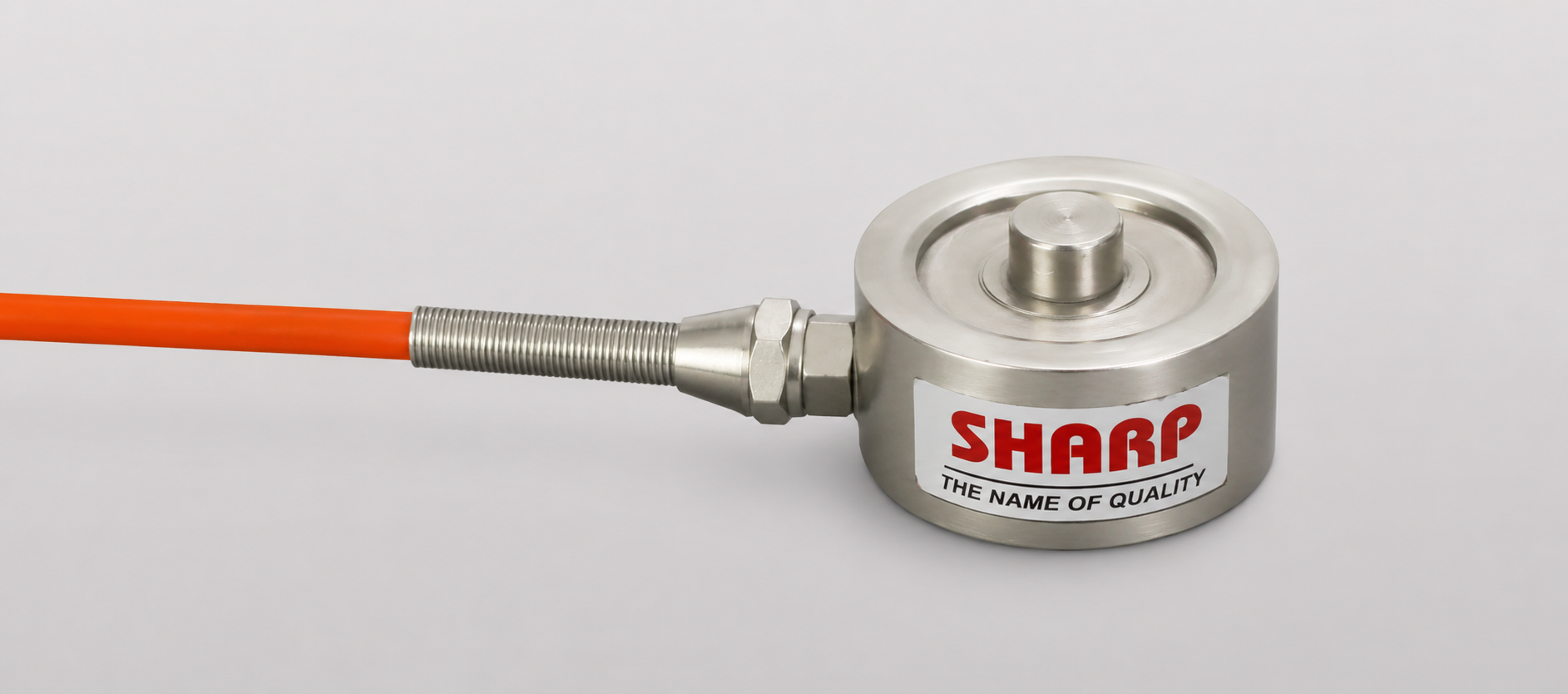
A load cell is an electronic sensor used to convert mechanical force or weight to an electrical signal. The signal is passed to a weighing indicator/controller to enable extremely accurate weight measurement.
These measurements are critical to the production of modern EVs for:
- Automated production lines
- Precision assembly
- Material handling
- Quality assurance
- Safety monitoring
- Robotic manufacturing systems
If load cells were not used, ensuring the same quality of product in EV manufacture would be very challenging.
Why Load Cells Are Critical in EV Manufacturing
Electric vehicles have hundreds of precisions engineered parts which need to be manufactured with tolerances less than 0.5%. Small differences in force or weight can impact the performance of a battery, the balance of a vehicle, efficiency and safety.
Load cells aid manufacturers in the following ways:- Improving production accuracy
- Preventing component overload
- Reducing manufacturing defects
- Increasing automation efficiency
- Supporting Industry 4.0 manufacturing
- Enhancing worker safety
Major Load Cell Applications in Electric Vehicle (EV) Manufacturing
The various applications of the major load cells in the electric vehicle manufacturing industry.
- A method to measure the weight of the battery module.
- Monitoring assembly forces
- Automated battery stacking
- Battery enclosure testing
- Battery lifting systems
- Quality inspection of batteries packs
- Detect gripping force
- Prevent excessive pressure
- Improve assembly precision
- Protect sensitive battery cells
- Perform force-controlled assembly
- Rotor balancing
- Stator assembly
- Press-fit operations
- Bearing installation
- Torque verification
- End-of-line testing
- Compression force
- Mechanical stress
- Cell deformation
- Safety testing
- Structural integrity
- Frame positioning
- Robotic welding
- Component alignment
- Suspension installation
- Structural verification
- Monitoring carried loads
- Preventing overloading
- Optimizing material movement
- Improving operational safety
- Enhancing automation efficiency
- Battery trays
- Charging connectors
- Cooling systems
- Suspension parts
- Brake assemblies
- Steering components
- Press force
- Assembly consistency
- Component seating
- Quality verification
- Process control
- Vehicle weighing
- Axle load distribution
- Suspension testing
- Brake force measurement
- Load balancing
- Conveyor systems
- Cranes
- Hoists
- Lifting platforms
- Storage systems
- Automated warehouses
- Shear Beam Load Cells
- Platform weighing
- Production lines
- Material handling
- Industrial automation
- S-Type Load Cells
Best suited for:
- Tension testing
- Compression testing
- Hanging systems
- Force measurement
- Button Type Load Cells
Suitable for:
- Compact machinery
- Press applications
- Assembly fixtures
- Compression testing
- Miniature Load Cells
Used in:
- Robotics
- Precision instruments
- Battery assembly
- Small automated equipment
- Column Load Cells
Designed for:
- Heavy industrial weighing
- Hydraulic presses
- Structural testing
- High-capacity applications
- Pin-Type Load Cells
- Crane monitoring
- Lift systems
- Material handling equipment
- Heavy machinery
- Higher Accuracy- Load cells offer extremely accurate measurements, ensuring consistency in the manufacturing process.
- Better Product Quality- Accurate force monitoring minimizes assembly defects.
- Increased Automation- Load cells can be easily integrated with Robotic production lines, PLCs, and SCADA systems.
- Improved Safety- Continuous load monitoring will ensure that no equipment overloads and no accidents will occur in the workplace.
- Reduced Production Costs- By catching out of control processes early, material waste and rework can be reduced.
- Higher Productivity- Automated measurement can accelerate production and yet maintain quality.
- Reliable Performance- Industrial load cells are built to perform in harsh industrial environments.
- PLC-based automation
- Industrial IoT (IIoT)
- MES systems
- SCADA platforms
- Data analytics software
- Predictive maintenance systems
- Load capacity
- Accuracy requirements
- Environmental conditions
- Mounting configuration
- Output signal compatibility
- Overload protection
- Long-term stability
- Ease of integration
EV Battery Pack Assembly- The most important component in an EV is a battery pack. All battery modules need to be built with utmost precision during the manufacturing process. The load cells are designed to measure:
Precise weighing guarantees each battery pack conforms to design requirements and minimizes assembly inaccuracies.
Robotic Assembly Systems-The factories of modern EVs are equipped with robots for battery, motor, chassis and electronic component assembly. Load cells help robots to:
This helps prevent damage to components and increase the production rate.
Electric Motor Manufacturing- Electric motors need to be assembled and tested correctly before being installed. Load cells are useful during:
The accurate measurement of the forces ensures smooth motor operation and a longer service life.
Battery Cell Compression Test- During the manufacturing and testing process, lithium-ion battery cells need to be compressed in a controlled manner. Load cells monitor:
Safe and controlled force is essential for manufacturers to ensure battery safety and performance.
Chassis Assembly- Vehicle chassis assembly is a task of lifting, positioning and connecting large parts. The load cells are used for:
Load measurement is accurate, which further increases vehicle dimensional accuracy.
Automated Guided Vehicles (AGVs)- Heavy components, motors, and batteries are moved through production facilities with AGVs. Load cells help by:
EV Component Testing- All components are thoroughly tested prior to final assembly. To assess the load cells in tests:
High precision force measurement assures that the product meets quality requirements.
Press-Fit Assembly Operations- Hydraulic or servo presses are used to assemble many components used in EVs. Load cells monitor:
This enables to remove faulty assemblies.
End-of-Line Vehicle Inspection- All EVs are meticulously checked before being delivered. Load cells assist in:
These tests provide for compliance with safety and performance standards for all vehicles.
Material Handling Systems-Automated material handling systems are employed in large EV manufacturing plants. Load cells are used in:
This increases efficiency and prevents the occurrence of overload conditions.
Types of Load Cells Used in EV Manufacturing
There are several load cell designs that can be used for various manufacturing processes.
Ideal for:
Ideal for:
Benefits of Using Load Cells in EV Manufacturing
The advantages of load cells in the EV sector are undeniable which as follow.
Integration with Smart Manufacturing- With Industry 4.0 as the norm, load cells now are increasingly connected with:
This allows manufacturers to track production on the fly, enhance process control, and optimize equipment performance.
Choosing the Right Load Cell for EV Manufacturing
When selecting a load cell, manufacturers should consider:
Why Choose Sharp Electronics?
Sharp Electronics has been serving industrial weighing applications since 2000 with ISO 9001:2015-certified manufacturing and customized weighing solutions. The company offers a wide range of precision load cells, weighing systems, installation, calibration, preventive maintenance, and automation integration services to meet the needs of modern industries.
Whether your requirement involves battery manufacturing, robotic automation, industrial testing, or customized force measurement systems, Sharp Electronics delivers reliable products engineered for accuracy, durability, and long-term performance.
Conclusion
Electric vehicle manufacturing demands exceptional precision at every stage of production. From battery assembly and robotic automation to quality inspection and final vehicle testing, load cells play a crucial role in ensuring accuracy,safety, and manufacturing excellence.
As EV production continues to grow worldwide, the demand for intelligent weighing and force measurement solutions will only increase. Investing in high-quality industrial load cells helps manufacturers improve productivity, reduce operational costs, and maintain the highest standards of product quality.
If you're looking for dependable load cells and customized weighing solutions for industrial automation, Sharp Electronics offers advanced products designed to support the evolving needs of the electric vehicle manufacturing industry with precision, reliability, and long-term performance.